Encoder wachendorff make About
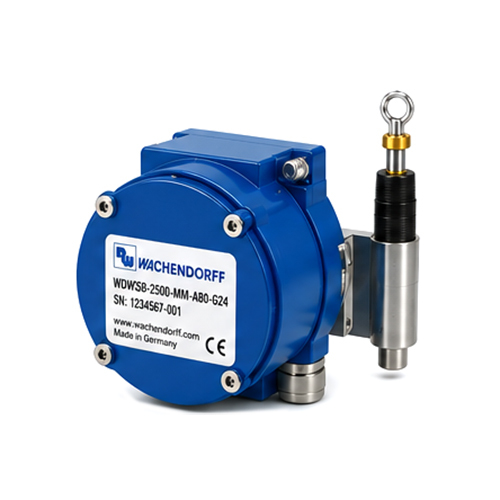
Wachendorff encoders are known for their high precision and rugged design, making them suitable for various industrial applications. They offer a range of encoders, including absolute and incremental types, with features like QuattroMag technology for single-turn encoders and EnDra technology for multi-turn encoders, ensuring accurate measurements with a maximum resolution of up to 16 bits and a measurement accuracy of +/- 0.09. Wachendorff encoders are widely used in industries such as automotive, robotics, material handling, and hydraulics, thanks to their reliability and durability. They are backed by a 5-year warranty and are designed to withstand extreme conditions, making them ideal for demanding applicationsBuilt for Reliable PerformanceEngineered for robustness and endurance, the Wachendorff encoder features a stainless steel measuring cable and a solid aluminum alloy housing. With shock resistance of up to 100 g, IP65/67 ingress protection, and a mechanical life exceeding 100 million cycles, it ensures reliable operation in demanding environments. Its blue housing not only distinguishes its premium build but also aids durability for extended use.
Versatile Output and ConnectivitySupporting both incremental and absolute output options, the encoder caters to varied automation requirements. Its compatibility with digital (HTL/TTL), analog, and industrial interfaces such as CANopen, PROFIBUS, and SSI (depending on model) allows seamless integration into existing control systems. The standard M12 connector and customizable cable length ensure fast and flexible installation.
Precision Measurement SolutionsThis rotary encoder delivers highly accurate position and linear measurements with resolutions up to 0.01 mm, making it ideal for applications requiring superior precision. A fast response time of under 1 ms and minimal backlash below 0.01 mm further enhance its accuracy and sensitivity, essential for material handling, position feedback, and intricate automation tasks.
FAQ's of Encoder wachendorff make:
Q: How is the Wachendorff encoder installed in industrial applications?
A: Installation is straightforward, with panel or machine mounting supported by an M4 thread. The M12 connector or cable allows easy plug-and-play connection, and the compact, robust design makes it suitable for a range of industrial setups.
Q: What types of measurements does this encoder support?
A: The encoder supports both position and linear measurement, with measurement ranges up to 2000 mm (model dependent). It provides high precision, suitable for tasks in automation, material handling, robotics, and factory position feedback.
Q: When should I choose a solid shaft stainless steel encoder for my project?
A: Opt for a solid shaft stainless steel encoder if you require high durability, corrosion resistance, and stable mechanical performance in harsh or demanding environments, such as in factories or automated material handling systems.
Q: Where can this encoder be used most effectively?
A: This encoder is ideal for use in industrial automation, robotics, factory automation, and material handling systems, particularly where precise position or length feedback is essential and environments may be exposed to dust, vibration, or shocks.
Q: What are the benefits of using a Wachendorff encoder with stainless steel cable and IP65/IP67 protection?
A: The stainless steel cable and high IP protection ensure the encoder withstands harsh conditions, including moisture and dust. This translates to a long lifespan, reduced downtime, and low maintenance needs, providing excellent value in critical automation applications.
Q: How does the encoder ensure high measurement accuracy and reliability?
A: With backlash under 0.01 mm, a fast response time of less than 1 ms, shock and vibration resistance, and measurement resolution up to 0.01 mm, the encoder excels in delivering consistent and accurate feedback, even under challenging industrial conditions.
Q: What output and signal options are available with this encoder?
A: Depending on the chosen model, the encoder can deliver incremental or absolute digital signals (HTL/TTL) as well as analog output. Supported interfaces include Parallel, SSI, CANopen, and PROFIBUS, offering flexibility for different control systems.



 Send Inquiry


 Send Inquiry